Reporting Japanese Acupuncture at an International Symposium in China

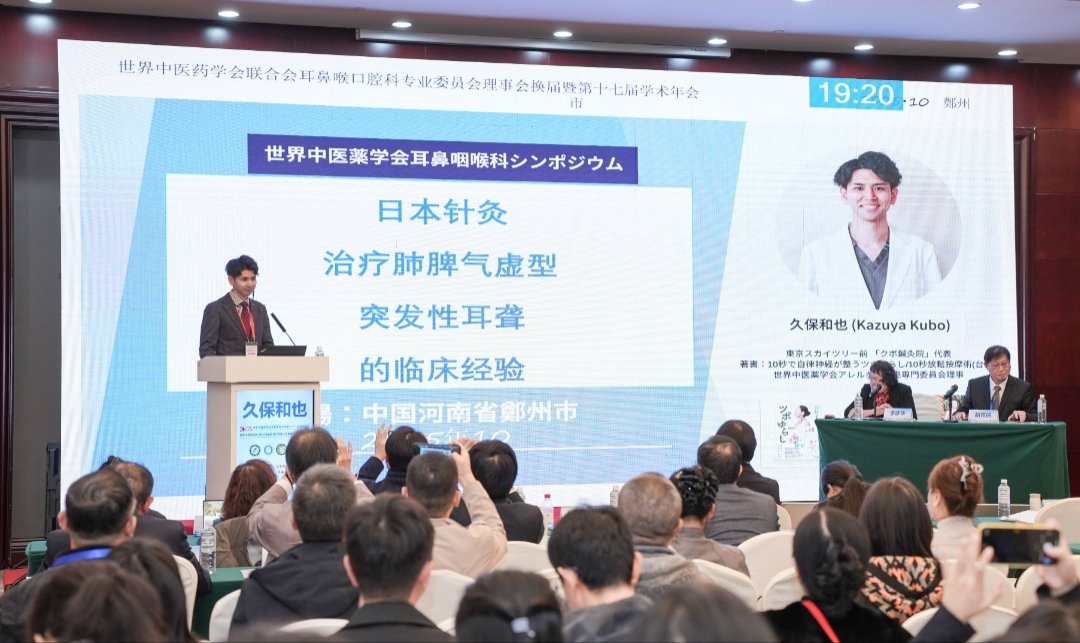
In October 2025, I had the privilege of presenting at the 17th Academic
Annual Meeting of the Otorhinolaryngology Specialty Committee, World
Federation of Chinese Medicine Societies (WFCMS), held in Zhengzhou,
Henan Province, China.
The symposium gathered physicians and acupuncturists from across Asia —
mainland China, Hong Kong, Taiwan, Korea, and beyond — creating a unique
forum for cross-cultural exchange in Eastern medicine.
A Clinical Approach from Japan

My presentation focused on a topic I have studied throughout my clinical
practice: “A Clinical Approach to Sudden Sensorineural Hearing Loss of
Lung-Spleen Qi Deficiency Type with Japanese Acupuncture.”
Sudden hearing loss is a condition often treated with corticosteroids in
Western medicine, yet many patients continue to experience symptoms even
after standard treatment. In Eastern medicine, this condition is often
understood through the lens of qi deficiency — a depletion of vital
energy in the lungs and spleen — and addressed accordingly.
Drawing from cases in my Tokyo clinic, I shared how Japanese acupuncture
approaches this pattern with a distinct methodology: shallower needling,
greater attention to the patient’s overall constitution, and a quieter,
more meditative treatment environment. The response from the international
audience was thoughtful and engaged, with active discussion afterward.
Why Japanese Acupuncture Stands Apart

While both Japanese and Chinese acupuncture share their roots in ancient
Eastern medicine, the two traditions have evolved differently over the
centuries.
Chinese acupuncture (中医) generally employs thicker needles and stronger
stimulation, aiming for clear, sometimes intense sensations during
treatment. Japanese acupuncture, in contrast, has refined a tradition of
exceptionally fine needles, gentle insertion, and minimal stimulation —
relying instead on subtle palpation and the practitioner’s heightened
sensitivity to qi.
This distinctly Japanese approach allows even those new to acupuncture,
or particularly sensitive to physical stimulation, to receive treatment
comfortably. It is often described by international guests as deeply
relaxing — a quiet, almost meditative experience rather than a clinical
procedure.
What I Bring Back to Tokyo

This international experience reinforced my conviction that Japanese
acupuncture offers something singular to the world: not merely a
treatment, but a quiet encounter with one’s own qi.
For my guests in Tokyo — many traveling from abroad — I continue to
offer this experience as it was meant to be: precise, gentle, and rooted
in two thousand years of Eastern wisdom, refined through generations of
Japanese practitioners.
To those who entrust their care to me, and to the colleagues across Asia
who shared this experience: thank you. The journey continues.
Experience Japanese Acupuncture in Tokyo
If you are visiting Tokyo and curious about the kind of acupuncture I
shared at the symposium, I welcome you to my private studio near Tokyo
Skytree — or to your hotel suite, by appointment.

By appointment only · 3 guests per day · From ¥50,000